|
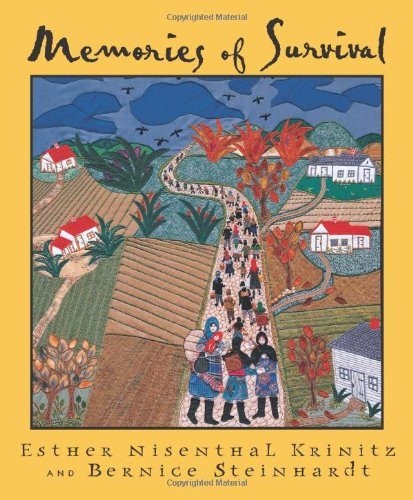
Esther Nisenthal Krinitz & Bernice Steinhardt, Memories of Survival (Graceteam, 2005) My family and I visit Baltimore fairly often. It's a fairly short drive down Route 83 and across the Mason-Dixon Line, and there's a lot to see and do there that isn't available here in south-central Pennsylvania. Often, we'll visit something like the National Aquarium or the Maryland Science Center or, when the kids were a little younger, we'd go to Port Discovery (before they replaced and ruined the central climbing structure). On a beautiful spring day this year, we went somewhere we'd never gone before: the American Visionary Art Museum, tucked away in the Federal Hill neighborhood not far from Inner Harbor. There was a diverse collection of exhibits in the museum, which is actually two buildings separated by a sculpture garden. And, while I enjoyed several of the collections and displays, one in particular caught my attention and dominated most of my time there. Its imagery, startlingly pastoral considering the topic, haunted me as I moved through other halls of the museum. And, when we inevitably stopped by the gift shop, I was thrilled to see a book about that specific exhibition for sale. Of course it came home with me. I'll be honest, I wasn't prepared for the emotional impact of needlework. But this collection of embroidered pieces by Esther Krinitz, in all its simple beauty, is like a punch to the gut.
In most of the scenes, Esther has hand-stitched a caption. In the book, the captions are reproduced in larger, more legible type, and when necessary Bernice provides additional commentary. It begins with an image simply titled "Childhood Home," a rustic scene that shows the Nisenthal family's house and farm in 1937, when Esther was 10 years old. Esther, with long pigtails, is shown from the back, hauling water from the well, along with her parents Hersh and Rachel, her older brother Ruven, and her younger sisters, Mania, Chana and the baby Leah. It is a peaceful scene, one where it is hard to imagine the horrible deeds to come. Other scenes of the family's pre-Nazi life follow: swimming in the Tucin River, tending the geese, feeding her brother a bowl of borscht while he hid from their parents in fear of punishment for fighting, walking on stilts through the fields with her siblings en route to a family gathering for Shavuot, a harvest holiday celebrated in June. Another shows her zayde (Yiddish for grandfather) Chaim and his neighbor Baresh, village patriarchs, conducting a Rosh Hashanah service in 1938. Next, Esther's mother and the women of Mniszek make matzos for Passover. These scenes are all simple and sincere, especially in comparison to what follows. The very next scene, from September 1939, shows the first Nazis arriving in the village. Esther and her friends watched in silence as a soldier abused her zayde and cut off his beard. Turn the page, and you'll see children forced to dig trenches under the supervision of armed Nazi guards. Esther's caption concludes: "None of these boys and girls survived the war: Itzhak, Mechel, Nachum, Golda, Elya, Hersh, Ruben." In an almost comical interlude, a piece titled "Toothache" shows Esther having a tooth pulled by a German dentist; suffering from pain, she had tricked soldiers at the Nazi camp into helping her. But the tone quickly turns darker; the next scene shows Esther, who was spreading manure in a farmer's field to earn money for her family, discovering her cousin Moishe in the neighboring labor camp of Goscieradow. And it keeps getting grimmer for the Jewish residents of Mniszek. Esther's father is beaten and threatened with execution during his prayers on the dying before Passover. Esther, while tending the family's cow in a green pasture, overlooks the Janiszow prison camp, where Jewish boys were worked until they couldn't work any longer, then taken into the woods and shot. Ordered to the labor camp, Esther's father and brother flee into the woods, living in a secret hut. Early one morning, the entire family was forced from their home in their nightclothes and threatened with execution. Esther, fetching clothing for her family minutes later, was struck by a soldier for not moving quickly enough. Soon, the family flees their home, separating to better their chances of not being found, and they soon learn that their cousin's elderly parents had been killed by the Gestapo. And all of this is illustrated in needlepoint. It's heartbreaking in its simplicity, shockingly beautiful despite the horror the images depict. And Esther keeps going. On Oct. 15, 1942, the Gestapo orders the Nisenthal family and the other Mniszek Jews to vacate their homes by 10 a.m. and take the road to the Krasnik railroad station "and then to their deaths." Knowing what likely awaited them, Esther and her sister Mania escape and seek refuge with Stefan, a non-Jewish friend of their father's. The two girls go one way, and "the wagons left for the Krasnik station, and we never saw our family again." And even their brief refuge turned sour, as Stefan feared the Nazis would discover the girls and kill his family for hiding them. And so, "after two days, he sent us out into the rain, with no place to go but the forest." With no other options, they chose new identities and posed as Polish Catholics ... but they still received word that the Jews of Mniszek had arrived in Krasnik, where "the Germans shot at them randomly and covered the square with bodies." Esther relates touching anecdotes, such as the time a kind German soldier who helped her draw water from a well -- not realizing, of course, that she was Jewish -- and the day when a swarm of honeybees drove a pair of overly inquisitive Nazis from the garden she was tending. On various nights, she and Mania hid in a forest, in a barn or on a debris pile to elude the Gestapo. One night, in her terror, a dream of her long-dead zayde gave her comfort. Then, in July 1944, a Russian patrol marched through their town. "Finally, freedom had come for Mania and me, but for the rest of our family, it was too late," she stitched beneath the jubilant scene. She tries to find evidence of her family's fate in Mniszek, then at the liberated concentration camp at Maidanek -- a scene that inspired her to join the Polish Army. One of the final pieces shows her unit crossing the Oder River into Germany, where they passed a battlefield where Russians "had hung Nazi officers on every tree along the road." The book ends on a hopeful note, with a scene of Esther's arrival in New York, with her new husband Max Krinitz, whom she had met in a refugee camp after the war, and their infant daughter Bernice. When I started this review, I had no intention of relating Esther's entire story ... but once I started, I couldn't stop. Her experiences were beyond terrible, and she lived through things I personally cannot imagine having to endure. To hold onto those memories and express them through art and beauty -- to keep those memories, of both her family and the Nazi scourge -- alive is a wonderful gift, and I feel blessed to have seen her collection with my own eyes. If you are not so fortunate, then definitely get this book and get to know the Nisenthal family through a survivor's eyes. [ visit the Art & Remembrance website ] 
|
 Rambles.NET book review by Tom Knapp 9 May 2026 Agree? Disagree? Send us your opinions!  



 |